


Breathwork for Anxiety That Feels Manageable

When anxiety arrives, it rarely asks whether you have time for it. It can appear before a meeting, during the school run, while lying awake at night, or in the middle of an otherwise ordinary day. Breathwork for anxiety offers a small, practical place to begin: not by forcing yourself to feel calm, but by giving your body a signal that it may be safe enough to soften.
Your breath is not a switch that can erase every worried thought. It is, however, one of the few parts of your nervous system that you can gently influence in the moment. With patient practice, breathing can become a reassuring anchor - something you can return to wherever you are.
Why anxiety can change the way you breathe
Anxiety is a natural protective response. When your brain senses pressure, uncertainty or danger, your body prepares to act. Your heart rate may rise, your shoulders may creep towards your ears, and your breathing can become faster, shallower or held altogether.
This response is useful when immediate action is needed. The difficulty comes when the body stays on alert long after the stressful moment has passed. A busy inbox, family responsibilities, poor sleep or a constant stream of news can all leave the nervous system feeling as though it must remain ready.
Gentle breathing practices can help interrupt that cycle. A slightly slower, more spacious breath gives your body different information: there is no need to rush right now. This does not mean you should try to breathe deeply at all costs. For some people, especially during a surge of panic, a big inhale can feel uncomfortable or make light-headedness worse. The aim is comfort, not performance.
Breathwork for anxiety starts with noticing
Before changing your breath, simply notice it. Are you breathing through your nose or mouth? Does the breath feel high in your chest, or can you sense gentle movement through the ribs and belly? Is there a pause where you are holding on without realising?
There is no correct answer. This moment of observation is already a form of body awareness. Rather than judging your breath as wrong, meet it with curiosity. You may find it helpful to place one hand on your chest and the other around the lower ribs, feeling for movement without trying to create it.
If closing your eyes makes you feel less settled, keep them open and let your gaze rest on something neutral in the room. A breath practice should help you feel more present in your body, not disconnected from your surroundings.
A simple longer-exhale practice
One of the most accessible approaches is to make the exhale a little longer than the inhale. The out-breath is often associated with the body’s settling response, and a gentle extension can encourage a sense of ease.
Sit supported in a chair, lie down with your knees bent, or stand with both feet feeling the floor. Let your shoulders be easy. Breathe in comfortably through the nose for a count of three, then breathe out softly for a count of four or five. There is no need to fill your lungs to their maximum capacity. Imagine you are breathing at a volume that feels quiet and sustainable.
Continue for five or six rounds, then return to your natural breathing. Notice whether anything has shifted. Perhaps your jaw feels less clenched, your belly has softened, or your thoughts feel fractionally less urgent. Small changes count.
If counting makes you tense or distracted, leave the numbers behind. Instead, think, “in” as you inhale and “soften” as you exhale. A practice only works when it feels kind enough to repeat.
Try a sigh of relief
A soft sigh can be useful when you have been holding tension in your chest, throat or shoulders. Breathe in gently through the nose, then exhale through the mouth with a quiet, unforced sigh. Let the shoulders drop naturally rather than pulling them down.
Repeat two or three times, then allow the mouth to close and return to an easy nasal breath if that is comfortable for you. This is particularly helpful after a difficult phone call, before moving from work into home life, or when you notice you have been bracing your body for hours.
Use movement to make breathing feel safer
Stillness is not always the best place to begin. If anxious energy is making you feel restless, pairing breath with slow movement can be more supportive than sitting and trying to be calm.
Try standing with your feet hip-width apart. As you breathe in, slowly sweep your arms forwards and upwards only as far as feels comfortable. As you breathe out, lower them again. Keep the movement unhurried and allow your knees to stay soft. After several breaths, pause and feel your feet connecting with the floor.
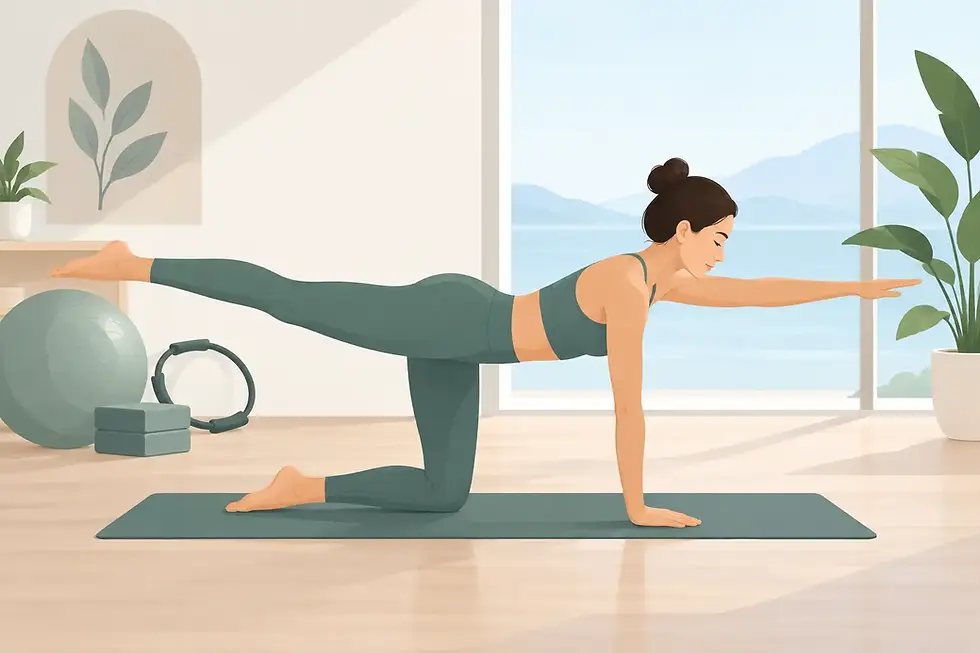
Gentle Pilates and mindful mobility can offer this same combination of movement, breath and attention. Rather than asking the mind to become quiet, you give it something steady to focus on: the shape of the movement, the support beneath you, and the rhythm of your breath. For many people, that feels more achievable.
When to practise, not just when anxiety peaks
Breathing tools are easiest to access when they are familiar. If you only reach for them at your most overwhelmed, they can feel like another task to get right. A brief daily practice helps build recognition, so your body begins to associate a slower exhale with a moment of care.
You might take three unhurried breaths before getting out of bed, after parking the car, while the kettle boils, or before sleep. Keep it realistic. Two minutes practised regularly can be more valuable than a twenty-minute routine you feel you ought to do but never manage.
It can also help to notice your personal anxiety patterns. Some people feel most wired in the morning; others experience a dip in the afternoon or find their thoughts race at bedtime. Choosing a regular moment that fits your life makes the practice feel like support, rather than another demand on your time.
What to avoid when you feel highly anxious
Not all breathwork is designed for calming. Fast, forceful or intense breathing techniques can create strong sensations, including tingling, dizziness and emotional release. While some people enjoy these practices in an appropriate setting, they are not necessarily the right choice when you already feel panicky, overwhelmed or ungrounded.
Start with a natural breath and a slightly longer exhale instead. Avoid holding your breath for long periods, straining to take a deep inhale, or continuing if you feel faint, numb, more agitated or uncomfortable. Return to normal breathing, look around the room, feel your feet on the ground and take a sip of water if you need to.
If you are pregnant, have a respiratory or heart condition, live with trauma-related symptoms, or have any concerns about breathwork, speak with a qualified healthcare professional before trying more structured techniques. Breathwork can be a valuable wellbeing tool, but it does not replace medical or mental health support. If anxiety is affecting your daily life, sleep, relationships or ability to cope, reaching out for professional help is a strong and worthwhile step.
Let your breath be part of your wider support
Anxiety usually responds best to a collection of small supports rather than one perfect solution. Sleep, nourishing food, movement, time outdoors, meaningful connection and appropriate professional care all have a place. Your breath can sit within that picture as a quiet, available companion.
At Reform Revitalise Release, breath is woven into movement with the understanding that every body and every day is different. Some days you may want to feel stronger and more energised. On others, the most helpful thing is to slow down, release physical tension and reconnect with yourself without pressure.
The next time you notice anxiety gathering pace, resist the urge to fix everything at once. Feel the surface beneath you, let your exhale become a touch longer, and allow that one gentle breath to be enough for now.


Comments